WATER
The property owner is responsible for all maintenance and repair of their water service line from the water meter to the building. This includes the interior plumbing of the home, the outside irrigation system, and the area where the property’s water system connects to the water meter.
NCWSA is responsible for pipes on the “street side” of the water meter, including all service lines and water mains extending throughout the community. NCWSA is also responsible for the water meter itself.
If it is uncertain whether a leak or related water issue resides in the public or the private water line, call Customer Service, 770-787-1375, M-F, 8:00 a.m. – 5:00 p.m.
SEWER
The property owner is responsible for all maintenance and repair of the private sewer service line from the point of connection with the public sanitary sewer main to the building. This includes the interior plumbing of the home, sewer stub outs, and the area where the property’s sewer line connects to the public sanitary sewer main.
NCWSA is responsible for public sanitary sewers, which are the underground wastewater pipes between manholes.
If it is uncertain whether a sewer blockage or related sewer issue resides in the public or the private sanitary sewer line, call Customer Service, 770-787-1375, M-F, 8:00 a.m. – 5:00 p.m.
There are several reasons for replacing a meter. The meter could be old or not sending a drive by reading signal. Sometimes a meter needs to be exchanged so that readings are accurate, and sometimes meters need maintenance. At times customers may question their usage, so NCWSA swaps their meter for a new one while testing the used one.
Our water rates are very competitive, if not lower, than most water agencies in our region.
If you believe your water bill is too high, you may have a leak. Here’s where to start:
The account is in arrears, meaning that money is owed and should have been paid to NCWSA earlier.
NCWSA received a request to locate and mark our underground pipes from GA 811.
Usually, a water meter is in the right of way in the front or on the side of your property. Occasionally, a meter will be found in other places.
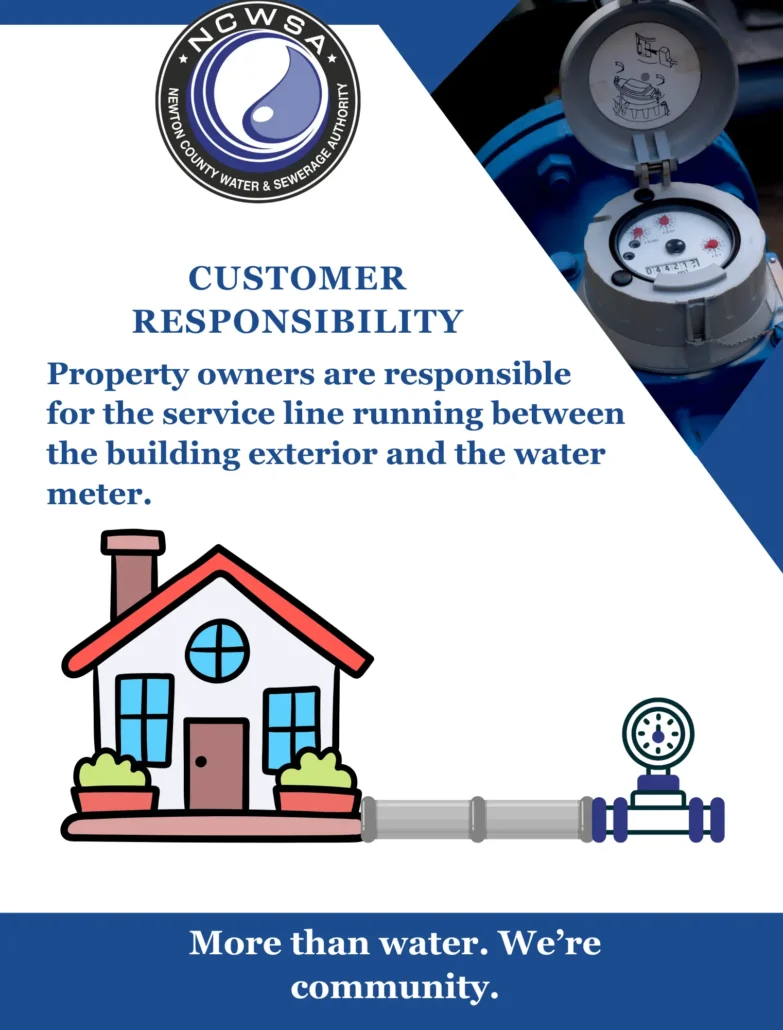
Property owners are responsible for the service line running between the building exterior and the water meter. NCWSA’s responsibility ends where a property owner’s service line begins due to liability.
NCWSA does not know what plumbers may charge for services.
If you need to find out the current balance on your bill, please call the main office at 770-787-1375.
NCWSA is an authority created by the Georgia State Legislature that is separate and autonomous from the Newton County Board of Commissioners. NCWSA receives no tax dollars.
No, there is a process for reconnecting your service.
Our technicians could be doing many things while being on a customer’s property. These include locking meters, manual meter reading, checking for leaks, placing the meter and/or meter box, checking endpoint, locking and unlocking meter, checking equipment, checking for zero, low, or high readings, tapping the main for a new customer’s meter being installed, repairing a main break, and renewing a service line.